A 40ft container commonly carries two or three vehicles. With compact cars and a professionally designed racking system, loading four vehicles may sometimes be possible. However, there is no single number that applies to every shipment.
The actual capacity depends on the dimensions and weight of each vehicle, the container type, the loading method, the securing system and the carrier’s acceptance requirements. For electric vehicles, battery condition, declaration procedures and safety rules must also be checked before booking.
This guide explains how vehicle importers can evaluate container capacity, compare loading options and estimate the shipping cost per vehicle without relying on an unsupported loading guarantee.
The Short Answer
As a general planning reference:
- Two vehicles: often suitable for large SUVs, pickups or a conservative flat-loading plan.
- Two to three vehicles: a common range for many standard vehicle shipments.
- Four vehicles: may be possible with compact models, compatible dimensions and a professional racking system.
These figures are estimates rather than confirmed capacity. Two vehicles with similar exterior styling can have different lengths, ground clearances, weights or underbody structures. The only reliable way to confirm the quantity is to prepare a loading plan using the exact vehicle specifications and the actual container equipment.
40ft GP vs 40ft High Cube
The two container types commonly considered for vehicle shipments are the 40ft General Purpose container and the 40ft High Cube container.
| Container Type | Typical Internal Length | Typical Internal Width | Typical Internal Height | Planning Consideration |
|---|---|---|---|---|
| 40ft GP | About 12.0 m | About 2.35 m | About 2.39 m | Suitable for many standard vehicle-loading plans |
| 40ft High Cube | About 12.0 m | About 2.35 m | About 2.69 m | Extra height may support certain racking or taller-vehicle plans |
Dimensions and payload ratings vary by container owner and equipment series. The container data plate, door opening and carrier restrictions must be checked before loading.
A High Cube container is taller, but additional height does not automatically mean that another vehicle can be added. The result still depends on the rack geometry, vehicle position, safe clearances, securing points and total load distribution. Door-opening dimensions can also be more restrictive than the nominal internal space.
Vehicle Dimensions That Affect Container Capacity
A loading assessment should use the specifications of the exact model and configuration, not a general description such as “sedan” or “SUV.” The following information is normally required:
- Overall length
- Overall width, including the position of the mirrors
- Overall height
- Kerb weight
- Ground clearance
- Wheelbase and overhangs
- Tyre and wheel dimensions
- Whether the vehicle can be driven and steered normally
- Location of approved towing or securing points
Minor specification differences can change the loading result. A panoramic roof, roof rail, larger wheel package, body kit or different suspension height may affect the required clearance. The actual export configuration should therefore be verified before the rack or securing arrangement is finalized.
How Capacity Changes for Sedans, SUVs and Pickups
Sedans and Compact Cars
Compact cars and standard sedans are generally easier to arrange because they are lower than most SUVs and shorter than many pickups. A professional rack may allow vehicles to be positioned at an angle, making better use of vertical space. Four compact vehicles may be possible in some combinations, but the plan must still provide adequate clearances and safe securing.
SUVs
SUVs are usually taller and wider. Their rooflines, increased ground clearance and higher centre of gravity can limit the angles available on a rack. Large off-road SUVs may also require more space around the body and undercarriage. Depending on the model, two or three SUVs may be a more realistic planning range.
Pickups
Pickup trucks often have a long wheelbase and greater overall length. Their height and weight may further restrict the loading arrangement. Even when the combined vehicle length appears acceptable, overhangs and the turning space needed during loading can make the proposed layout impractical.
Vehicle count alone is therefore not a useful comparison. A container carrying two large pickups may be using its available space as efficiently as a container carrying three sedans.
Flat Loading vs Professional Racking Systems
The loading method has a major influence on capacity, cost and risk.
| Loading Method | How It Works | Potential Advantage | Main Consideration |
|---|---|---|---|
| Flat loading | Vehicles remain on the container floor | Simpler loading and unloading | Usually uses less vertical space |
| Inclined loading | One or more vehicles are positioned at a controlled angle | May improve space utilization | Requires suitable supports and clearance checks |
| Professional racking | Engineered frames support vehicles in planned positions | Can increase capacity for compatible models | Adds rack, labour and unloading requirements |
| Mixed-model loading | Different vehicle types are arranged in one container | May suit a mixed purchase order | Needs an individual dimensional layout |
Some special plans may involve folding mirrors, removing selected detachable parts or making other preparations. Any adjustment must be documented and agreed in advance. A vehicle should not be dismantled simply to achieve an attractive headline quantity if doing so increases damage risk, reassembly work or customs complications.
Loading one more vehicle is not a saving if the method increases body damage, undercarriage damage or unloading costs.
How Electric Vehicles Change the Loading Plan
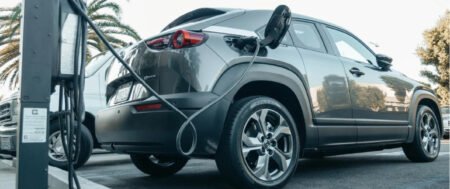
Battery electric vehicles and plug-in hybrids require additional checks. EVs are often heavier than comparable petrol vehicles, and the high-voltage battery is commonly installed beneath the passenger compartment. The loading and securing system must not press against or damage the battery enclosure, underbody protection or high-voltage components.
An EV loading plan should consider:
- Vehicle kerb weight and combined container payload
- Battery location and protected underbody areas
- Approved wheel, towing and securing points
- Battery condition and any visible damage or warning messages
- Required state of charge at handover
- Vehicle key management and transport mode
- Whether the auxiliary battery must be disconnected
- Dangerous-goods classification and documentation
- Carrier, port and destination-country acceptance rules
There is no universal state-of-charge figure that should be applied to every route. Requirements can vary between carriers, ports, vessel types and vehicle programs. The shipper should obtain the applicable requirement in writing for the specific booking.
Vehicles with damaged, defective or suspect batteries may require special assessment or may not be accepted. Used EVs should therefore be inspected before booking, especially if they have collision, underbody, flood or battery-related damage.
Why Vehicle Count Is Not the Only Cost Factor
Increasing the number of cars in a container can reduce the ocean freight allocated to each vehicle, but it does not always produce the lowest landed cost. Importers should also consider:
- Professional racking-system charges
- Loading and securing labour
- Storage before container loading
- Vehicle preparation or parts removal
- Additional inspection and documentation
- Damage exposure and insurance conditions
- Destination unloading equipment and labour
- Rack disposal, return or handling at destination
- Demurrage or detention if unloading is delayed
For example, a four-car racking plan may reduce the freight allocation per vehicle but require specialized unloading equipment at the destination. If that equipment is unavailable, the apparent saving can quickly be lost through delay, extra handling or vehicle damage.
Simple Shipping Cost per Vehicle Formula
(Container freight + loading and securing + racking system + origin handling + insurance + destination unloading) ÷ number of vehicles = estimated shipping cost per vehicle
This calculation is useful for comparing different loading plans, but it is not the complete landed cost. Import duty, VAT or sales tax, customs clearance, inland delivery, inspection, registration and other destination charges may still apply.
Information Needed for a Vehicle Loading Plan
To assess whether two, three or four vehicles can be loaded, provide the following information:
- Make, model, model year and exact configuration of each vehicle
- Quantity of each model
- Length, width and height of every model
- Kerb weight of every vehicle
- Power type: BEV, PHEV, hybrid, petrol or diesel
- New, used, accident-damaged or non-running condition
- Whether every vehicle can drive, steer and brake normally
- Port of loading and destination port
- Preferred container type: 40GP or 40HQ
- Whether professional racking is acceptable
- Available unloading method at the destination
Photos of the actual vehicles, particularly the front, rear, sides, roof and underbody, can help identify accessories or damage not shown in a standard specification sheet.
Common Vehicle-Loading Mistakes
- Estimating capacity by vehicle category alone. “SUV” does not provide enough information to design a safe loading plan.
- Using dimensions from the wrong configuration. Different model years and trims can have different bumpers, wheels, roof rails and suspension heights.
- Ignoring door-opening dimensions. A vehicle may appear to fit inside the container but still be difficult or impossible to move through the doorway safely.
- Forgetting mirrors and body accessories. Mirrors, spoilers and roof accessories affect clearance.
- Checking volume but not weight. Vehicle weight, rack weight and load distribution must remain within equipment and operational limits.
- Using unsuitable securing points. Straps, chains or supports must not damage the body, suspension, brake lines or EV battery area.
- Leaving insufficient clearance. Vehicles and frames can move during handling and sea transport.
- Failing to document loading. Photos of vehicle condition, rack installation and final securing are valuable for quality control and claims.
- Ignoring destination unloading. A loading system that works at origin must also be safely removable at the destination.
- Presenting an estimate as a guarantee. Capacity should only be confirmed after the final layout and operational checks.
40ft Container Loading Checklist
| Check | What to Confirm |
|---|---|
| Vehicle specifications | Exact model, configuration, length, width and height |
| Vehicle weight | Individual weight, combined weight and rack weight |
| Container type | 40GP or 40HQ, actual dimensions and payload rating |
| Loading method | Flat, inclined, mixed-model or professional racking |
| Clearances | Doorway, roof, side, underbody and vehicle-to-vehicle space |
| Securing points | Approved points that avoid body and battery damage |
| EV requirements | Battery condition, SoC, declaration and shutdown procedure |
| Carrier acceptance | Booking, documentation and route-specific requirements |
| Destination unloading | Required equipment, labour, space and rack handling |
| Evidence | Pre-loading condition photos and final securing records |
FAQ
Can four cars fit in a 40ft container?
Four cars may fit when the vehicles are compact and a suitable professional racking system is used. It should not be assumed for every shipment. Exact vehicle dimensions, weight, rack design, clearances and destination unloading capability must be checked first.
How many SUVs fit in a 40ft container?
Two or three SUVs may be a useful initial estimate, but the actual number depends on the size and weight of each model. Large off-road SUVs may limit the shipment to two, while smaller crossovers may allow a different arrangement.
Is a 40ft High Cube better for shipping cars?
A 40ft High Cube provides additional internal height, which can help with certain tall vehicles or racking systems. It is not automatically the best option. Availability, freight rate, rack design, vehicle height and unloading arrangements should all be compared.
Can EVs and petrol cars be loaded in the same container?
A mixed shipment may be possible, subject to correct classification, declaration, carrier acceptance and safe loading procedures for every vehicle. Approval should be obtained for the specific booking rather than assumed from a previous shipment.
Is container shipping cheaper per vehicle?
It can be, particularly when several compatible vehicles share the freight and handling costs. The comparison should include racking, loading, insurance and destination unloading—not ocean freight alone.
What information is needed to confirm container capacity?
At minimum, provide the exact vehicle models, quantities, dimensions, kerb weights, power types, operating condition, loading port and destination port. Photos and destination unloading details can make the assessment more reliable.
Request a Vehicle Loading Assessment
The number of cars that fit in a 40ft container should be treated as an engineering and logistics question, not a fixed sales claim. A practical plan must balance space utilization, vehicle protection, carrier compliance and destination handling.
Send EVSTrader the vehicle models, quantities, dimensions, power types and destination port. Our team can help assess the container option, loading method and estimated shipping cost per vehicle for your order.