Charging compatibility is one of the most important checks when importing an electric vehicle from China. A vehicle can have an attractive price, good battery health and the right driving range, yet still be difficult to operate locally if its charging inlet, communication protocol, onboard charger or voltage requirements do not match the destination market.
The issue is more complex than identifying the shape of the plug. Importers need to check alternating-current (AC) charging and direct-current (DC) fast charging separately, confirm whether the vehicle is a China-market or export-spec version, and verify the exact configuration of every vehicle in the order.
This guide explains GB/T, Type 2, CCS2 and other common charging standards, why an adapter does not automatically guarantee compatibility, and what evidence international dealers should request before purchasing Chinese electric vehicles.
Quick Answer: Will a Chinese EV Charge in Another Country?
It may, but compatibility must be verified before purchase. Many vehicles built for the Chinese domestic market use GB/T charging connections, while export versions of Chinese models may be equipped with CCS2, CCS1 or another destination-market standard.
Successful charging depends on more than the physical connector. Importers should verify:
- The vehicle’s AC charging inlet and communication method
- The vehicle’s DC fast-charging inlet and communication protocol
- The voltage, frequency and phase supported by the onboard charger
- The maximum AC and DC charging power accepted by the vehicle
- The plug and protocol used by local home and public chargers
- Whether an adapter or conversion has been tested with that exact model
- Whether the proposed equipment is certified and supported locally
A plug that physically fits does not prove that the charger and vehicle can communicate or charge safely.
Why Charging Compatibility Must Be Checked Before Purchase
Chinese vehicle manufacturers often produce several regional configurations of the same model. A domestic-market vehicle and an export version may share the same exterior, battery size and model name but use different charging inlets, onboard-charger specifications, software or connectivity services.
This means that a model-level brochure is not enough. A dealer should not assume that every BYD, Geely, Chery, GAC, Zeekr or other Chinese vehicle uses the same connection worldwide. The exact trim, market version, production batch and VIN-linked specification matter.
Finding a mismatch after the vehicles arrive can lead to:
- Inability to use local public fast chargers
- Slow or unreliable home charging
- Additional adapter or conversion costs
- Compatibility problems across different charger brands
- Reduced resale value and customer confidence
- Warranty, insurance or certification questions
- More complex after-sales support for the importer
The least expensive solution is usually to confirm compatibility before the purchase contract is finalised, rather than trying to correct an incompatible configuration after arrival.
What Are GB/T, Type 2, CCS2, CCS1, CHAdeMO and NACS?
These names refer to different vehicle charging connection systems and standards. They are not interchangeable simply because they all transfer electricity.
| Charging System | Typical Use | Commonly Encountered In | Importer Note |
|---|---|---|---|
| GB/T AC | AC charging | Mainland China and some import markets | China-market vehicles commonly use a GB/T AC inlet |
| GB/T DC | DC fast charging | Mainland China and selected networks elsewhere | Physically and technically different from CCS2 |
| Type 2 | AC charging | Europe and many other international markets | Often forms the AC portion of a CCS2 vehicle inlet |
| CCS2 / Combo 2 | AC and DC charging architecture | Europe and many markets using European-oriented infrastructure | Common on export-spec vehicles for relevant markets |
| CCS1 / Combo 1 | AC and DC charging architecture | Historically common in parts of North America | Do not confuse with CCS2; the connector design differs |
| CHAdeMO | DC fast charging | Japan and some legacy international networks | Availability varies and may be declining in some markets |
| NACS / SAE J3400 | AC and DC charging | North America | Vehicle and network support must be checked; it is not the same as GB/T |
The table describes common market patterns, not a legal or technical rule for every country. Charging networks can contain several connector types, and infrastructure continues to change.
GB/T vs CCS2: What Is the Difference?
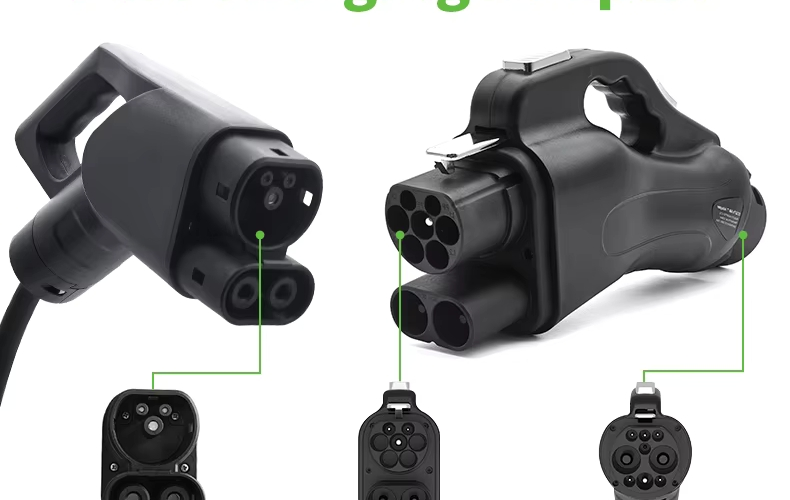
GB/T is the family of Chinese national standards used for conductive EV charging connections. The current GB/T 20234 series defines general, AC and DC connection requirements. CCS2, also called Combo 2, combines a Type 2-based AC connection with additional DC contacts and a CCS communication architecture.
| Check | GB/T | CCS2 |
|---|---|---|
| Primary association | Chinese domestic charging ecosystem | European-oriented CCS ecosystem and other adopting markets |
| AC connection | GB/T AC interface | Type 2-based interface |
| DC connection | Separate GB/T DC interface | Combo 2 interface with additional DC contacts |
| Physical fit | Does not directly mate with CCS2 | Does not directly mate with GB/T |
| Communication | Uses the applicable GB/T control and communication system | Uses the CCS communication system |
| Typical vehicle version | Many China-market EVs | Many export-spec EVs for CCS2 markets |
The practical conclusion is simple: converting the shape of the connection is only one part of the problem. The vehicle and charger must also agree on signalling, communication, voltage and safe charging limits.
AC Charging and DC Fast Charging Must Be Checked Separately
One of the most common purchasing mistakes is treating all charging as a single function.
AC Charging
During AC charging, the charging equipment supplies alternating current and the vehicle’s onboard charger converts it to DC for the traction battery. The vehicle’s onboard charger therefore determines important limits, including supported input voltage, phase and maximum charging power.
An AC adapter may bridge a physical connector difference in some situations, but the buyer must still verify control signalling, earthing, cable rating, local electrical supply and the onboard charger’s input specification.
DC Fast Charging
During DC fast charging, the charging station supplies controlled DC power to the vehicle. The station and vehicle must communicate continuously to manage voltage, current, battery status and safety conditions.
For this reason, DC compatibility can require active protocol translation rather than a simple passive change in connector shape. A device advertised as a GB/T-to-CCS2 adapter should not be assumed to work with every vehicle or every charging network.
A successful AC charging test does not prove DC fast-charging compatibility, and a successful test on one charger does not guarantee operation across an entire public network.
Can a GB/T Vehicle Use a CCS2 Charger?
Potentially, but the answer depends on the charging type, vehicle, adapter or conversion system, charger network and local requirements.
Situation 1: The Connectors Do Not Physically Match
A China-market GB/T inlet and a CCS2 connector cannot be directly connected. A suitable interface device or a properly engineered vehicle conversion would be required.
Situation 2: The Connector Is Adapted but Communication Differs
For DC charging, changing the physical interface alone does not resolve differences in communication. An active device may need to translate between the charger and vehicle protocols. Its compatibility, firmware, electrical ratings and safety protections must match both sides.
Situation 3: The Vehicle Has Been Converted
Some suppliers offer charging-port conversions. A conversion can involve more than replacing an inlet: wiring, control hardware, software, the charging controller and safety functions may need to be integrated and tested.
Before accepting a converted vehicle, ask who performed the work, which components were changed, whether the work affects the manufacturer’s warranty, what certification applies, and whether the vehicle was tested on the destination market’s actual charging equipment.
Why an Adapter Does Not Automatically Guarantee Compatibility
Adapter listings frequently focus on plug names, current ratings and maximum voltage. Those specifications are important, but they do not prove complete vehicle-to-charger interoperability.
Importers should check:
- Direction: An adapter designed for one vehicle-and-charger direction may not work in reverse.
- AC or DC: An AC adapter is not a DC fast-charging solution.
- Communication: DC charging may require active protocol conversion.
- Voltage range: The adapter, charger and vehicle battery architecture must overlap.
- Current and thermal limits: Claimed peak ratings do not necessarily describe sustained operation.
- Firmware: Vehicle or charger software updates may affect behaviour.
- Network variation: Results can differ among charger manufacturers and operators.
- Certification and support: The importer needs traceable documentation, warranty support and a responsible supplier.
For dealer inventory, a single short demonstration is not enough. Ask for repeatable tests that reflect how customers will actually charge the vehicle.
Voltage, Frequency and Onboard-Charger Checks
The connector receives most of the attention, but the vehicle’s electrical input limits are equally important for AC charging.
Request the following information for the exact vehicle version:
- Supported AC input-voltage range
- Supported frequency, such as 50 Hz or 60 Hz
- Single-phase or three-phase capability
- Maximum AC input current
- Maximum onboard-charger power
- Supported DC charging-voltage range
- Maximum DC charging power under applicable conditions
- Required protective earthing and residual-current protection
A vehicle with a high advertised DC fast-charging figure may still have a relatively modest AC onboard charger. Likewise, a local 22 kW AC charge point does not mean that every connected vehicle will charge at 22 kW. Actual power is limited by the lowest compatible capacity in the vehicle, cable, charge point and electrical supply.
China-Market Version vs Export Version
For an international dealer, the cheapest available domestic-market vehicle is not automatically the lowest-risk choice. Export-spec versions may be better aligned with the destination market, but their specification must still be checked.
| Item | China-Market Version | Export Version |
|---|---|---|
| Charging inlet | Often GB/T | May use CCS2, CCS1 or another destination-oriented standard |
| Onboard charger | Configured for its original market specification | May be configured for the intended export market |
| Software language | May prioritise Chinese-language functions | May include market-specific languages |
| Navigation and connectivity | Domestic services may not function abroad | May include regional services, subject to market support |
| Warranty and diagnostics | Overseas support may be limited | Potentially better aligned with authorised local support |
| Purchase price | May appear lower | May include the cost of market-specific equipment and compliance |
Ask the supplier to state the market version in the contract and attach the relevant charging specification. Do not rely only on the model name or exterior photos.
Charging Compatibility by Destination Market
The following table is a planning guide only. Infrastructure can vary by country, city, network operator and installation.
| Market Area | What Importers May Encounter | What to Verify |
|---|---|---|
| Middle East | Type 2 and CCS2 are common in several major public networks, while imported GB/T vehicles also exist | Country, charger network, AC supply, DC protocol and availability of supported equipment |
| Africa | Infrastructure differs widely; some markets have limited public fast charging and greater reliance on home or depot charging | Local grid, installation capacity, connector mix, fleet route and service support |
| Europe | Type 2 and CCS2 are widely established | Whether the vehicle is true CCS2 export specification and meets local approval requirements |
| Central Asia | GB/T and CCS-type infrastructure may coexist depending on country and import patterns | The actual charging network on the dealer’s target routes |
| Latin America | Connector and electrical systems vary among countries | Country-specific infrastructure, voltage, frequency and homologation |
| North America | CCS1 and NACS/J3400 ecosystems are relevant; local rules and networks continue to evolve | Connector, protocol, import eligibility, electrical specification and network access |
Instead of asking whether a vehicle “works in Africa” or “works in the Middle East,” specify the destination country, city, expected charging locations and intended customer use.
What Should Importers Request Before Ordering?
A reliable supplier should be able to provide vehicle-specific evidence rather than a generic statement such as “adapter included.” Request:
- Clear photos of the actual charging inlet: Photograph all AC and DC ports with covers open.
- VIN-linked market version: Confirm whether each unit is domestic or export specification.
- Charging-standard statement: Identify AC and DC connector and protocol separately.
- Onboard-charger specification: Include voltage, frequency, phase and maximum AC power.
- DC charging limits: Include voltage range and maximum supported power.
- Adapter or conversion documentation: Record manufacturer, model, ratings, certification and warranty.
- AC charging test: Show connection, charging status, power and stable operation.
- DC fast-charging test: Use the applicable interface and record successful communication and power delivery.
- Warning-light and fault-code scan: Confirm no charging-system faults are present.
- Destination test where practical: Verify operation with representative local charger models or obtain written compatibility evidence.
For a bulk order, evidence should be tied to the vehicles or a clearly controlled configuration batch. Testing one sample does not prove that every unit has the same hardware and software.
Common Charging Compatibility Mistakes
- Checking only the plug shape: Communication and electrical compatibility matter too.
- Confusing Type 2 with CCS2: Type 2 usually refers to the AC interface, while CCS2 adds DC contacts and CCS functionality.
- Testing AC but promising DC: The two charging paths require separate verification.
- Assuming every vehicle of one model is identical: Market version, trim and production batch can differ.
- Accepting “adapter included” without specifications: Direction, AC/DC use, protocol, rating and support must be documented.
- Ignoring the onboard charger: Local charge-point power does not override the vehicle’s AC limit.
- Using regional generalisations: Charging conditions vary by country and network.
- Overlooking software and connectivity: Charging initiation, apps and remote functions may depend on regional services.
- Skipping after-sales planning: Dealers need replacement cables, diagnostic capability and technical support.
- Making guaranteed charging claims: Compatibility should be supported by defined test conditions and written evidence.
Chinese EV Charging Compatibility Checklist
| Item | Information to Record | Status |
|---|---|---|
| Destination | Country, city and expected charging networks | Confirm |
| Vehicle identity | VIN, model, trim, year and market version | Confirm |
| AC interface | Connector, signalling and cable requirement | Confirm |
| DC interface | Connector and communication protocol | Confirm |
| AC electrical input | Voltage, frequency, phase, current and maximum power | Confirm |
| DC input | Voltage range and maximum charging power | Confirm |
| Adapter/conversion | Manufacturer, model, direction, rating, certification and warranty | If applicable |
| Charging test | Separate AC and DC evidence under defined conditions | Confirm |
| Software | Language, charging settings, updates, app and connectivity | Confirm |
| Local support | Installer, diagnostic tools, spare cables and technical contact | Confirm |
FAQ
Can Chinese electric vehicles charge outside China?
Yes, many can, especially when they are built to the correct export-market specification. A China-market vehicle may require an adapter, conversion or compatible GB/T infrastructure. Verify the exact vehicle and local charging network before purchase.
Is GB/T compatible with CCS2?
They are different physical and communication systems and do not connect directly. Compatibility may be achieved in some cases through suitable equipment or an engineered conversion, but it must be validated for the vehicle and charger.
Can a GB/T-to-CCS2 adapter enable DC fast charging?
Some active devices are designed for this purpose, but compatibility is not universal. Confirm protocol translation, voltage and current limits, vehicle model support, charger-network performance, certification and after-sales support.
Do Chinese EVs support 220V or 240V charging?
Many vehicles may operate within relevant voltage ranges, but the answer must come from the exact onboard-charger specification. Voltage alone does not confirm connector, phase, frequency or communication compatibility.
Is an export-spec vehicle better than a China-market version?
An export-spec vehicle may reduce charging, software and compliance risks when it is configured for the destination. However, the importer should still verify the actual inlet, charger specifications and local approvals rather than relying on the label “export version.”
Can the charging port be converted before export?
Conversions may be available for selected models, but the scope can extend beyond the inlet itself. Ask for component details, test evidence, warranty terms, certification and confirmation that vehicle safety functions remain operational.
How can an importer verify the charging configuration?
Request VIN-linked specifications, clear inlet photos, onboard-charger data, separate AC and DC test records, adapter or conversion documents and evidence from representative destination-market charging equipment.