Quick Answer
What are the most important global EV market trends for vehicle importers in 2026? Electric-car demand continues to grow, but purchasing conditions are becoming more regional. Battery-electric vehicles are gaining share in markets with mature charging networks, while plug-in hybrids and extended-range electric vehicles remain relevant where charging access is less consistent. China continues to play a central role in global EV production and trade, but importers must evaluate more than the vehicle price. Charging compatibility, destination-market compliance, battery condition, shipping costs, spare parts and local after-sales capability can determine whether a vehicle is commercially viable.
For dealers and fleet buyers, the practical lesson is clear: there is no single EV inventory strategy that works for every country. Models and specifications should be selected according to local regulations, infrastructure, climate, customer use and total landed cost.
1. Global EV Market in 2026
The global electric-car market entered 2026 from a record base. According to the International Energy Agency’s Global EV Outlook 2026, global electric-car sales exceeded 20 million units in 2025, increasing by approximately 20% from the previous year. Electric cars represented one in four new cars sold worldwide.
The IEA expects global electric-car sales to reach approximately 23 million in 2026, equivalent to about 28% of total car sales. This is a forecast rather than a completed annual result, and actual performance may vary as economic conditions, policy changes and supply constraints evolve.
Growth is not uniform across regions:
- China: More than 13 million electric cars were sold in 2025, accounting for around six out of every ten electric cars sold globally.
- Europe: Electric-car sales reached about 4.2 million in 2025. In the first half of 2026, battery-electric cars captured 20.7% of new EU registrations, according to the European Automobile Manufacturers’ Association.
- Emerging markets: Adoption is growing, but the pace depends heavily on vehicle affordability, import policy, charging availability and the economics of fuel and electricity.
These differences matter to international dealers. A vehicle that sells well in a market with widespread fast charging may not be the right product for a country where most buyers depend on home charging or frequently travel between cities.
2. China’s Role in Global EV Supply
China remains the largest manufacturing and trading centre for electric cars. The IEA reports that nearly 22 million electric cars were produced worldwide in 2025. China accounted for nearly 75% of global electric-car production and approximately 40% of global electric-car trade. These figures reflect China’s scale across vehicle assembly, batteries, power electronics and related components.
Official Chinese data also show rapid export growth. China exported 2.615 million new-energy vehicles in 2025, double the previous year’s total. During the first four months of 2026, China’s NEV exports increased by 120% year on year, according to information published by the State Council Information Office.
For international buyers, China’s supply base offers several potential advantages:
- A wide range of BEV, PHEV and EREV models
- New and used vehicle availability
- Compact cars, sedans, SUVs, MPVs and commercial vehicles
- Multiple battery sizes and trim levels
- Opportunities for standardized or mixed-model orders
Scale, however, does not remove purchasing risk. Chinese domestic-market specifications may differ from official export versions. Importers should confirm the exact VIN, model year, production date, powertrain, battery, charging connector, software language and included accessories before approving an order.
3. BEV, PHEV and EREV Demand Is Becoming More Regional
The term “electric vehicle” covers several powertrain types. Importers should avoid treating them as interchangeable.
| Powertrain | How It Works | Potential Market Fit | Important Checks |
|---|---|---|---|
| BEV | Powered only by a traction battery and electric motor | Markets with reliable home or public charging | Connector, charging protocol, realistic range and battery condition |
| PHEV | Combines a rechargeable battery with an internal-combustion engine | Markets where buyers want electric driving with fuel backup | Charging, emissions rules, engine maintenance and fuel compatibility |
| EREV | Uses an engine primarily to generate electricity for the drive system | Long-distance use and markets with uneven charging coverage | Local classification, registration, service knowledge and parts support |
BEVs can be a strong choice where charging access is predictable and local incentives favour zero-emission vehicles. PHEVs and EREVs may be easier to introduce in markets where public charging remains limited, buyers travel long distances or power supply is inconsistent.
This does not mean that one powertrain is universally better. Tax treatment, import duties and registration categories can also differ between BEVs, PHEVs and EREVs. Dealers should confirm how the destination country classifies each vehicle before purchasing. For additional market context, see EVstrader’s guide to long-range PHEVs in Middle Eastern and African used-car markets.
4. Pricing Pressure and Dealer Margins
Competitive vehicle prices can create opportunities, but the supplier’s quoted unit price does not equal the importer’s final cost. A commercially sound purchasing decision should be based on total landed cost.
Depending on the trade term and destination, total landed cost may include:
- Vehicle purchase price
- Domestic transportation within China
- Inspection or reconditioning
- Export documentation and handling
- Port and loading charges
- Ocean freight
- Marine cargo insurance
- Import duty, VAT or other taxes
- Destination-port and customs-broker charges
- Local inspection and registration
- Charging accessories or technical adaptation
- Spare parts, warranty reserves and after-sales support
Dealers should compare vehicles on the basis of expected retail price, inventory turnover and after-sales cost—not only the FOB quotation. A lower purchase price can be offset by poor parts availability, incompatible charging hardware or weak local demand.
5. Compliance Is Becoming More Important
A vehicle that can be purchased and exported from China is not automatically eligible for import or registration in another country.
Before sourcing begins, the importer should verify:
- Whether new and used vehicles are both permitted
- Maximum vehicle age and mileage rules
- Left-hand-drive or right-hand-drive requirements
- Model approval or conformity requirements
- Safety, energy-efficiency and emissions rules
- Charging connector and electrical compatibility
- Required inspection and certification
- Customs valuation and tariff classification
- Importer licensing and registration procedures
Documentation should remain consistent across the vehicle, commercial invoice, packing list, inspection report, shipping instructions and bill of lading. The VIN is especially important because a discrepancy can lead to amendments, additional inspection or delayed release.
Importers can review five documentation mistakes that can delay vehicle imports at destination ports. Final destination-country requirements should be confirmed with a licensed customs broker or the relevant authority before shipment.
6. Used EV Battery Transparency
As the global EV fleet grows, more used electric vehicles are becoming available for cross-border trade. This can improve price choice for dealers, but it also increases the need for battery transparency.
Dashboard range alone cannot confirm the condition of a used traction battery. Displayed range can change with temperature, driving style, climate-control use, road conditions and recent energy consumption.
Depending on the model and available diagnostic access, buyers should request:
- Estimated State of Health
- Remaining usable battery capacity
- Battery and high-voltage fault codes
- Cell-voltage consistency
- Battery temperature information
- Charging-system condition
- Dashboard warning records
- Available charging or service history
- Road-test energy consumption
Diagnostic availability differs by manufacturer. A supplier should identify which values came directly from the vehicle, which were estimated and which could not be obtained.
The battery report should also be connected to the corresponding VIN. Buyers can find a broader sourcing and inspection framework in EVstrader’s guide to sourcing reliable electric vehicles from China.
7. Shipping and Supply-Chain Changes
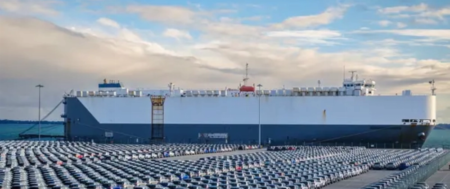
Vehicle logistics involve more than reserving space on a vessel. The importer and exporter should agree on the shipping method, loading process, documentation timeline and risk responsibilities before the vehicles reach the port.
| Shipping Method | Potential Advantages | Points to Confirm |
|---|---|---|
| Container | Enclosed handling and potential mixed-model consolidation | Vehicle dimensions, loading plan, securing method and destination unloading |
| Ro-Ro | Efficient loading for running vehicles and larger batches | Route availability, sailing frequency, carrier acceptance and port handling |
| Flat Rack | Can accommodate oversized or special vehicles | Exposure, securing requirements and additional handling costs |
Mixed-model shipments can help dealers test demand without purchasing a large quantity of one model. They also require more planning because different vehicles may have different dimensions, charging accessories, spare-parts needs and destination-country approvals.
Before shipment, buyers should request vehicle condition photographs, loading records, VIN lists, securing photographs, the container seal number when applicable and confirmation of marine insurance. EVstrader’s 30-unit used EV shipment to the Middle East provides an example of batch vehicle preparation and container dispatch.
8. What These Trends Mean for International Dealers
The 2026 EV market creates more sourcing choices, but dealers need stronger selection and verification processes. The following actions can reduce avoidable purchasing risk:
- Do not select inventory by price alone. Compare total landed cost, expected retail demand and after-sales exposure.
- Confirm import eligibility before purchase. Do not wait until the vehicle reaches the port to check local requirements.
- Verify charging compatibility. Check the connector, voltage, onboard charger, communication protocol and available local infrastructure.
- Start with a manageable first order. A smaller or mixed-model shipment can help test local demand before a larger commitment.
- Keep VIN-level records. Link each vehicle to its quotation, inspection report, battery information and shipping documents.
- Plan parts and diagnostics. Confirm whether common service parts, diagnostic tools and technical information can be supported locally.
- Standardize bulk orders where possible. Align model year, trim, battery, wheel specification, charging configuration and software version.
9. Global EV Market 2026: Importer Checklist
| Checkpoint | What the Importer Should Confirm |
|---|---|
| Market demand | Target customer, budget, body type and expected resale price |
| Powertrain | BEV, PHEV or EREV suitability for local driving and charging |
| Vehicle identity | VIN, model year, production date, trim and ownership status |
| Battery | Available SoH, capacity, cell consistency and fault codes |
| Charging | Connector, onboard charger, protocol and local compatibility |
| Compliance | Import, conformity, customs, inspection and registration rules |
| Commercial terms | Unit price, quantity, Incoterm, payment schedule and quotation validity |
| Logistics | Shipping method, loading plan, insurance, documents and destination costs |
| After-sales | Parts, diagnostics, software limitations and warranty conditions |
10. Frequently Asked Questions
What is the global EV market outlook for 2026?
The IEA expects global electric-car sales to reach approximately 23 million in 2026, representing about 28% of total car sales. Growth rates and powertrain preferences will continue to differ by country.
Are BEVs or PHEVs growing faster?
There is no single global answer. BEVs are expanding in markets with stronger charging networks and zero-emission policies, while PHEVs remain important in markets where charging access, long-distance travel or customer preferences favour fuel backup. Importers should evaluate local registrations and regulations rather than applying a worldwide trend to one market.
Why are Chinese EVs important to international importers?
China offers a large selection of electric vehicles across different brands, body types and price levels. It is also the world’s largest electric-car manufacturing centre. Importers must still verify specifications, export documentation, charging compatibility and local registration eligibility for each model.
What should dealers check before importing Chinese EVs?
Dealers should confirm vehicle identity, condition, battery, charging configuration, software, destination-market compliance, total landed cost, parts availability, shipping method and after-sales support.
Can Chinese domestic-market EVs be used overseas?
Possibly, but compatibility is not automatic. Buyers should check charging connectors, voltage, software language, navigation, mobile applications, network connectivity, replacement parts, local registration and warranty limitations before purchase.
Can an exporter guarantee customs clearance?
No exporter can guarantee a decision by the destination-country authorities. An experienced exporter can reduce avoidable errors by preparing accurate vehicle information and coordinating documents with the importer, carrier and customs broker before shipment.
11. Request Current EV Inventory and FOB/CIF Pricing
EVstrader supports international dealers, distributors, rental companies and fleet operators sourcing new and used vehicles from China. Depending on the selected vehicles and destination, our team can coordinate sourcing, VIN-level information, available inspection records, commercial documentation and shipment planning.
To receive suitable vehicle options, please provide:
- Destination country and port
- Buyer type and intended market
- Preferred brands and models
- BEV, PHEV or EREV
- New or used condition
- Required quantity
- Preferred model year and maximum mileage
- Target budget per vehicle
- Required trade term, such as FOB or CIF
- Expected purchasing schedule
Contact EVstrader for Current Inventory and FOB/CIF Pricing
Market data, regulations, vehicle supply and model specifications may change. Buyers should reconfirm current vehicle information and destination-country requirements before placing an order.